


South Carolina Is In, So What About the Final 7?

South Carolina is officially in.
With its announcement yesterday that it will begin administering the NextGen UBE in July 2028, South Carolina becomes the 49th jurisdiction to have already committed to the new exam. That leaves just seven jurisdictions still on the sidelines.
And that’s really the story now.
This is no longer about whether the NextGen UBE will become the dominant bar exam. It already has. The question now is what these remaining jurisdictions are signaling by waiting, studying, or, in some cases, building something entirely different.
Here’s where each of the seven remaining jurisdictions stands.
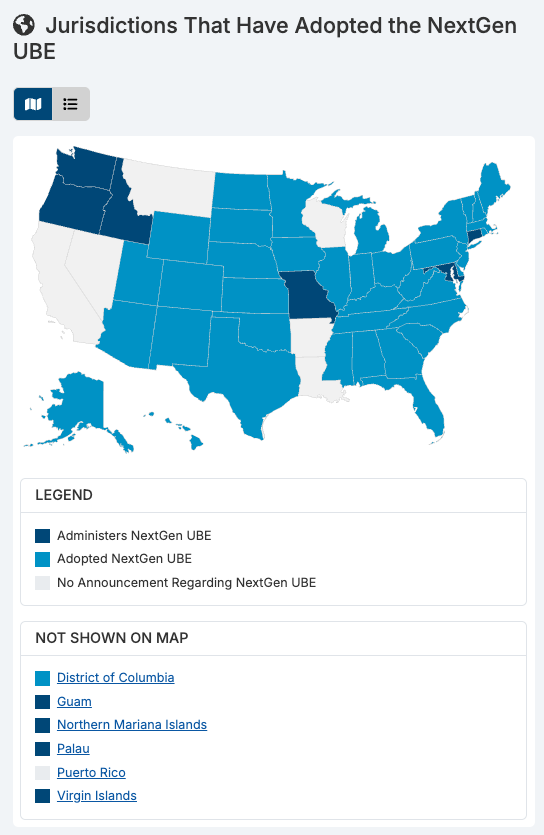
Arkansas — NextGen Adoption Likely
Arkansas already administers the Legacy Uniform Bar Exam, which makes the transition to NextGen more evolutionary than revolutionary.
The Arkanas Board of Law Examiners has recommended adoption beginning in July 2028, and the Arkansas Supreme Court is studying implementation details like cut scores and whether to add a state-specific component. That posture is consistent with a jurisdiction preparing for transition rather than questioning the underlying model.
Already a Legacy UBE jurisdiction, Arkansas has already bought into portability and national alignment. The NextGen UBE is simply the updated version of that system.
California — NextGen Adoption Unclear
California is a big question mark at this point.
It doesn't use any components of the Legacy UBE and instead administers its own state-specific exam. That independence has long been a defining feature of California licensure. But after the February 2025 bar exam issues, momentum shifted. The State Bar has approved exploring adoption of the NextGen UBE as early as 2028, and California law school deans have pushed strongly in that direction.
Still, California hasn't committed. It continues to consider alternatives, including maintaining a California-specific exam or designing a hybrid model.
Because it's not currently a Legacy UBE jurisdiction, adoption would represent a fundamental shift from where it sits now. That’s why California remains a “maybe,” even with increasing pressure to adopt the NextGen UBE.
Louisiana — NextGen Adoption Unlikely
Like California currently, Louisiana does not use any components of the Legacy UBE. Instead, Louisiana administers a fully state-specific exam grounded in its civil law system. That doctrinal uniqueness isn't a minor difference. Rather, it's central to how Louisiana trains and licenses lawyers.
Therefore, adopting the NextGen UBE would require abandoning or significantly restructuring that approach. Nothing in Louisiana’s recent actions suggests that is on the table.
Montana — NextGen Adoption Likely
Montana is another UBE jurisdiction that appears poised to transition.
In early 2026, both the Montana Board of Bar Examiners and the State Bar jointly petitioned the state supreme court to adopt the NextGen UBE, with a proposed rollout as early as February 2028. The court has already opened the proposal for public comment, with the public comment period ending May 15, 2026.
This, and the fact that Montana has already committed to the UBE framework makes the transition from Legacy UBE to NextGen UBE less about policy change and more about modernization.
Nevada — NextGen Adoption Unlikely
Nevada isn't just a non-UBE jurisdiction. It's been actively moving away from the traditional bar exam model altogether.
Through the Nevada Comprehensive Licensing Examination (the “Nevada Plan”), the state is implementing a new system that includes a foundational law exam, a lawyering performance assessment, and supervised practice beginning in 2027.
That is a wholesale redesign of licensure rather than a tweak. A jurisdiction investing in its own model is highly unlikely to pivot to the NextGen UBE anytime soon.
Wisconsin — NextGen Adoption Likely
Wisconsin does not currently administer the Legacy UBE and occupies a unique position because of its diploma privilege.
Graduates of in-state law schools can be admitted without taking a bar exam, which reduces the urgency of adopting any uniform bar exam. At the same time, Wisconsin has been actively studying whether to adopt the UBE, with proposals that would pair it with a Wisconsin-specific educational component.
In December 2025. the Wisconsin Board of Bar Examiners petitioned the Supreme Court of Wisconsin to adopt the Legacy UBE beginning with the July 2026 administration. But that short request even forced the BBE to recognize "this is am ambitious timeline." In the same petition, the BBE requested that "In July of 2028, the Board would begin administering the successor UBE exam, currently known as the 'NextGen' Exam."
Puerto Rico — NextGen Adoption Unlikely
Puerto Rico, like Louisiana, maintains a jurisdiction-specific licensing system and doesn't currently administer the Legacy UBE.
Its bar exam is tailored to local law and practice, and it doesn't accept UBE score transfers. Structural differences—including language and doctrinal focus—further distinguish it from the national testing model.
As with other non-UBE jurisdictions that prioritize local control, adoption of the NextGen UBE appears unlikely absent a major policy shift.
What This Means Going Forward
For students, the format of the bar exam shapes decisions about where to sit for the exam and how portable their scores will be.
For law schools, it affects how closely curricula align with the NextGen framework.
And for the profession, it raises a broader question: How much uniformity is desirable in a system that has historically balanced national standards with local control?


